
Amazing Reason the Piano has Black and White Keys
Today’s pianos have the black and white keys that we take for granted. Have they always been like that? Why black and white anyway?

The early pianos were actually named “pianoforte” which means an instrument that makes soft and loud sounds. This was a very new and different instrument than the harpsichord, which only had one volume because the strings were plucked like a harp.
Pianoforte eventually shortened to “piano.” In a later article I’ll go into the differences between the harpsichord, pre-harpsichord instruments, the fortepiano and pianoforte, and Mozart’s piano that had a pedal-board!
But now, the question: Why black and white keys? When harpsichords and pianofortes were made initially they had white wood with some ivory. Why ivory? Because it is a whitish color and contrasted well with the black. Those black keys were mostly made with rosewood or ebony because they are naturally dark-colored wood.
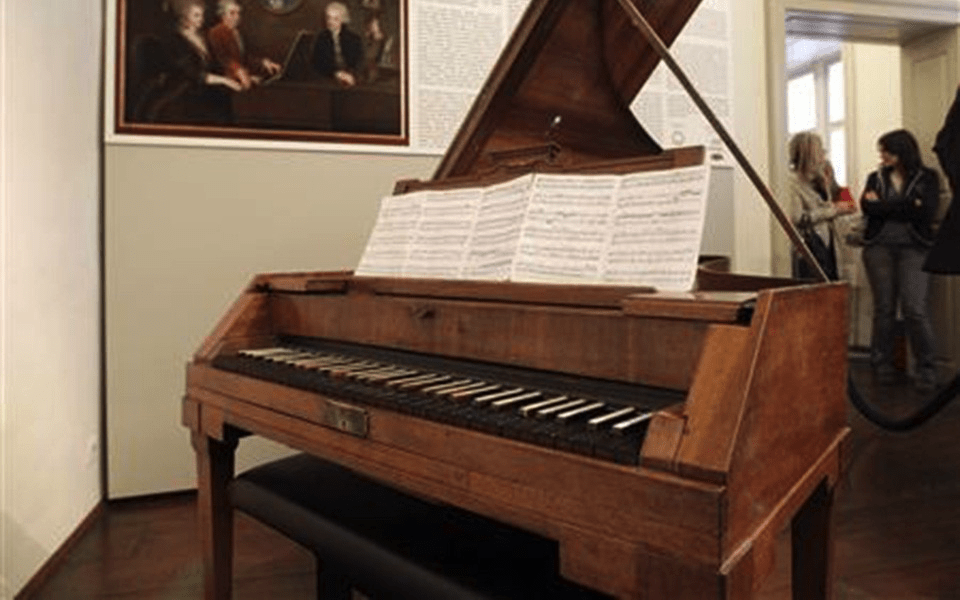
Here’s a photo of Mozart’s pianoforte that he used in the 18th century until his death in 1791.
Originally the raised keys were white and the longer keys were black. How strange that seems to us today! One reason these pianos had the raised keys made of white ivory was cost. It was more expensive to use ivory than wood so the fewer keys that had ivory the more affordable was the instrument. You may wonder why weren’t all keys just painted black or white. The feel of ivory keys is a very satisfying touch, absolutely not like paint. It’s like the difference in feel between artificial fur and the real thing. Currently, modern piano keys are made with a plastic finish. Some models have plastic keys with an ivory feel.
White and black became black and white keys!
This new pianoforte instrument really caught on and became extremely popular. Sometime in the 1800s the key colors were reversed, with black on the short raised keys and white on the long keys. There does not seem to be any documentation as to exactly when and why this happened, but it makes sense if you think about it.
A long row of black keys makes it more difficult to locate a specific key. It’s just harder to see the separation of keys in peripheral vision. Plus white stands out more, and black recedes as a darker color. Some may have thought it just plain looked prettier to have more white than black!
Why are there groups of 2 and 3 black keys?
If there was just a continuous row of raised black keys above a continuous row of white keys, it would be extremely difficult to locate specific keys. Cover a section of your piano’s black keys with a paper. Your orientation completely disappears! We can’t find our way around the white keys if there are no black key groups.
Why not have all groups be of two or three keys only? Again, our orientation would completely disappear – it all would look the same. To have the sequence of two black keys – three black keys marks the distance of an octave which is playing frequently (the distance of 8 letter names or 13 physical keys). No matter if the octave used is C to C or A flat to A flat, having the black keys in groups of two and then three makes it easy to navigate about the keyboard. Black and white keys as they are placed are essential to playing the piano.
Today’s pianos have the black and white keys that are a joy to touch and very durable.
 Previous Post

Great information. So interesting,
Anita Robbins