Top 7 Amazing Reasons Piano Lessons Make Students Smarter PLUS a Look at the Best Beginner Piano Books in 2026

Ever wondered if piano lessons make students smarter and do better in other school subjects? It’s hard to say that they don’t. There’s a variety of processes the brain goes through during piano practice that should aid school performance – in general or specifically. Here is a published list of benefits from learning just one foreign language – and piano is like learning two different languages at the same time!
Top Benefits
- Boosts brain power
2. Improves memory
3. Enhances the ability to multi-task
4. Sharpens the mind
5. Improves concentration for longer
6. Enhances decision-making
7. Improves performance in other academic areas

Learning the language of music means the brain must deal with new patterns and complexities – sometimes several at one time. Key learning skills are developed from this new thinking process of reading and playing music. This also expands memory because of the brain work-out!
The “Wow!” Factor
Imaging tests with fMRI and PET scanners show that “playing music is the brain’s equivalent of a full-body workout.” Activity all over the brain is greatly increased in an instrument-performer as opposed to a music-listener. Playing a musical instrument engages practically every area of the brain at once, especially the visual, auditory, and motor cortices, in intricate, interrelated, and astonishingly fast sequences. It increases the activity in the corpus callosum, the brain’s bridge between the two hemispheres. Solving nonmusical problems should come easier since the information travels more quickly, efficiently, and through more diverse routes. (1)

Reading and playing piano is a great example of multi-tasking, which is very demanding work for the brain. Being good at multi-tasking can reduce stress levels and help make you feel more “on top of” things.
There’s also the coordination that’s developed through eye-hand-mind reading and playing of music notation; the improvement of listening skills; the development of tenacity and discipline in order to practice regularly. All of this contributes to how piano lessons make students smarter by increasing problem-solving skills.

Reading music notation and going through the processes to actually play that written music on the piano (or other instrument) increases thinking skills. This increase creates benefits in higher scores on standardized tests in problem-solving tasks.
A Very Interesting Study about Music and Students
It seems piano lessons make students smarter,
and they do better in other school subjects!

Peter Gouzouasis is a professor of music education at the University of British Columbia and senior author of the Journal of Educational Psychology study of over 110,000 Canadian students. He has been studying the effects of music education on academic achievement for over two decades and has found that highly engaged music students were one year ahead in their English, science, and math skills compared to peers who had not taken any music classes.
Gouzouasis “saw a predictive relationship between high music grades and high mathematics achievement — meaning students who received high grades in their music lessons tended to also do better in math.
Whether or not your student is part of an official study, it does seem apparent that music lessons, (piano especially because of its complexity of using two hands to read two different clefs) contribute to making students smarter in other ways!
PIANO Revolution is an easier way to learn piano for students . . .
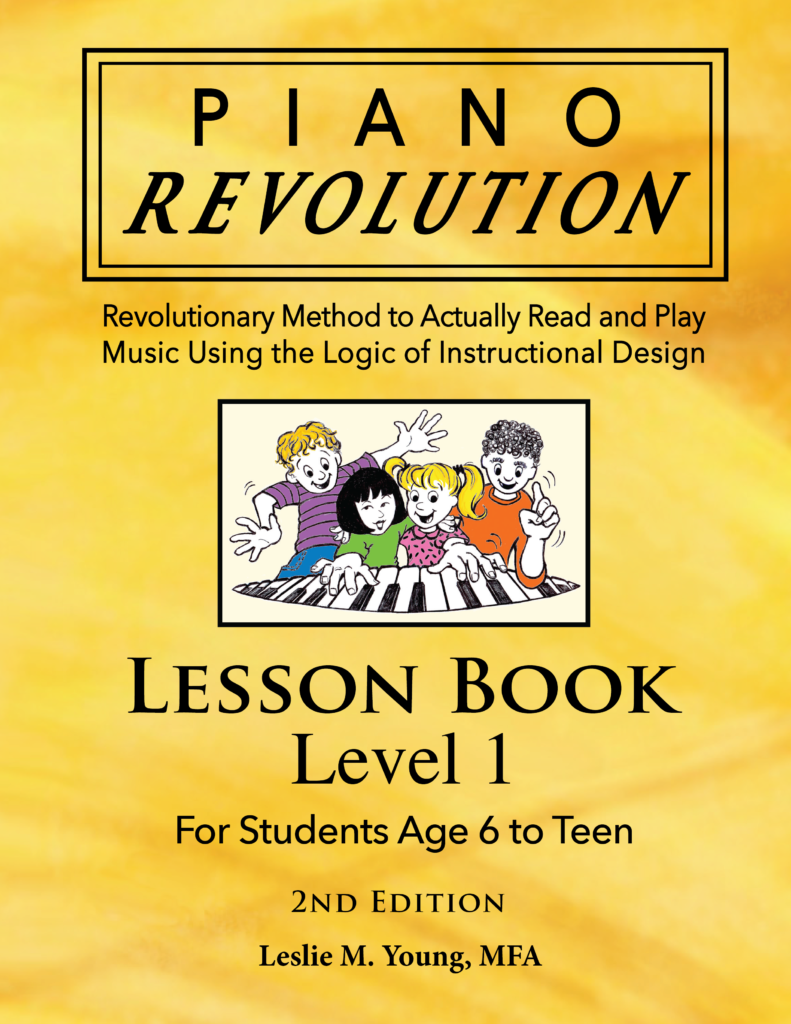
With the PIANO Revolution books, (the best beginner piano books) students start on Center F in just the right hand. Center F is the bottom space on the treble clef. There are no hand positions, but the student orients on this F key because it’s under the piano brand name and easy to locate using the closest group of three black keys. It also is the lowest space on the staff.


- Orient on the staff using treble space F to identify spaces first
(later use spaces to identify lines) - Orient on the piano using the treble space F key by
locating the center three black key group - Use the space notes/keys to find the line notes/keys
- Spend more time actually learning notes; use no hand positions that become crutches
- Must name the note as its key is played
- Learn the right and left hand clefs separately, THEN play together
- Build confidence by methodically increasing one skill at a time
- Learn early to play by touch
Using center F and its key as orientation points, the student uses a guided thinking process to identify and locate other keys. After awhile, the thinking process becomes automatic, which allows playing to be smooth and enjoyable.
Looking for a Homeschool Piano Method?
If you’re homeschooling and want a method that actually teaches your child how to read and play music, PIANO Revolution is for you. These are the best beginner piano books, in my opinion, and based on facts.
🎵 Ideal for:
- Homeschool families
- Busy parents
- Private piano teachers
- Self-taught piano learners
- College music major students needing fast, accurate piano skills
🎹 With PIANO Revolution, students:
- Build true sight-reading skills
- Progress efficiently and confidently
- Develop real musical independence—no more relying on memory mnemonics, hand position fingering, or videos
The Backstory:
Why I Created PIANO Revolution
Teaching Beginners to Read Music
Personal Reflection by Leslie M. Young, author of Piano Revolution
Leveled Piano Instruction Books in Four Series
Why It Matters


The writing and proving of the PIANO Revolution books has been a decades-long journey for me. The longer I used the method as a teacher, the more frequently I saw the lasting benefits for students of various ages. This approach truly teaches learners—proven with ages 5 to 65—how to actually read and play written music from the very first lesson. It’s not just about pressing keys. It’s about unlocking literacy in music and having true independence at the piano.
Story about Actual Student #1

My new neighbor approached me about teaching her ten-year-old daughter piano. She had had two years of lessons previously, so I expected her to know quite a bit. I was so surprised to see she couldn’t read a single written note. So we started from scratch with my beginner lesson book 1. She said aloud each letter name as she played its key and used the spaces as starting points to find the line notes – using the PIANO Revolution thinking method.
After three months, she was reading on a one-year level. This reaffirmed to me that its the method that makes the most difference in learning to accurately read and play music; not the teacher; not the age; not the piano; not past experience. This student continued and excelled beautifully.
Result: Method matters more than age or past experience.
About Actual Student #2

I met this lovely 65-year-old grandmother in 2017. She was quite accomplished in many areas, but wanted to learn to play piano. I told this from-scratch beginner that if she practiced ten minutes a day using my first lesson book, saying each letter name as she played its key, she would progress quickly.
She astonished me. After just four months, she played the original version (both hands) of Clementi’s Sonatina! Not quite up to speed, but accurately! She (and I) were quite happy with her accomplishments!
Result: The PIANO Revolution method works for any motivated learner.
Story about the Frustrated Teacher
A very experienced piano teacher I know was having difficulty with a teen student who just was not making any progress. This student had come to her with a background of having had lessons for a few years, but he never made the connection between reading notes and locating their corresponding keys.
I could see this teacher’s frustration and heard her say perhaps the problem was with herself. I emphatically reassured her that was not the case. The issue was with the method book currently used and those previously used. They really were the same in their approach of orienting on middle C and using hand positions and finger numbers – just rote memorization.

I encouraged her to take a new approach. Start from scratch with my beginner book for older teens and adults. Just stop “cold turkey” with the hand positions and finger numbers and replace that with learning one hand/clef at a time and say each letter as its key is played. That is actual learning that cannot be faked by a student with a “good ear”.
Remind the student frequently that letters will not have to be said forever – just until solid long-term learning has occurred. That’s usually after lessons covering two books in the series. This teacher was certainly happier after our conversation, and I understand now that the teen has mastered notation-reading!
NOTE: The PIANO Revolution method should be easy to use in homeschool lessons by parents with no music experience, as well as for self-teaching older students.
The Power of Instructional Design
In 1982 I found a course at the University of North Texas to be most enlightening! It was about how Instructional Design principles can be used to teach anyone anything in a way that should practically guarantee successful learning. That one experience reshaped how I thought about teaching. It showed me that learning doesn’t have to be rote copying tied to hand positions and finger numbers—it can be logical, clear, and empowering. That’s exactly how PIANO Revolution is structured – now.
I realized in the 1980s that just marking out most of the printed finger numbers in songs would not solve the root problem. Those songs were purposefully written in “hand positions” so that only certain notes would be read and certain piano keys played. A student has 10 fingers. A piano has 88 keys. Instant problem.

To alleviate this problem in the beginner’s first book, I searched for recognizable songs in the public domain that would fit my new “thinking process” strategy. This also meant new songs would have to be written to provide enough sequential progress for the student. There were years spent writing and rewriting.
Then something fantastic was created . . . the Internet! . . . and with it the capability for self-publishing books! New notation software – print on demand – no inventory – the book in your hand three days from ordering – amazing! This new “thinking process” method could be in the hands of teachers, students, and parents – all over the world.
The Thinking Process: Step-by-Step
- Learn each staff separately to understand treble and bass clefs clearly.
- Identify spaces first, then use them to name and find line notes.
- Practice short, daily sessions (5 to 7 minutes).
- Self-correct mistakes using the spaces to name/locate the lines.
This process turns students into independent learners who can “figure it out” on their own—one of the most rewarding things a teacher can hear! The beginner learns each hand’s staff separately. This makes sense because each staff represents different portions of the piano keyboard—meaning that the lines and spaces of each staff have different letter names. After the spaces are gradually learned (and the location of their piano keys), the spaces are used to name and locate the line letter names and key locations, in a gradual and logical sequence.

This “thinking process” that the student acquires within a short time of repeated practice is exciting for a teacher to see in action and self-motivating for the students because they can self-correct any errors. I’ve had a student say, “I can figure this out myself, so why do I need a teacher?” That was very satisfying for me to hear!
Method that Empowers Students to Teach Themselves

The evolution of structured teaching to read written music and perform it has spanned about 150 years. The Bertini Pianoforte Method of the 1880s was more like an encyclopedia of everything piano rather than a graduated method for beginners to learn to read and play – but it was a start. In the years after Bertini’s book appeared, other method books were published, including Beginners’ Book of the Oxford Piano Course in 1928 and John Thompson’s Modern Course for the Piano in 1942.
There are certainly more that followed, but current modern piano method books seem to be organized in the same general way as that of the 1880s: Systematically gathering beginner concepts together, leading to more difficult, and then the even more difficult – this IS the methodology.

PIANO Revolution gives students independence. It teaches them not just to play by rote-copying, but to understand. Not just to perform, but to logically think.
Here’s a fun and short
cartoon video that shows the Thinking Process used in PIANO Revolution books:

Ready to Start?
What Would the First Lesson for a Young Student Look Like?
📘 Explore sample pages and learn more at pianorev.com
What Would the First Lesson for a 6 to Teen Look Like (video)?
View sample pages of all the books for students
ages 6 to teen:

View sample pages of all the books for students
4 to 5 years old:
View sample pages of all the books for older
teens and adults:
View the books on Amazon:


About the Author, Composer,
Illustrator, Educator, and
Eternal Optimist
Leslie Young is the author, composer, and illustrator of PIANO Revolution method books (originally titled as the Revolutionary Piano Method). She co-founded a K-12th grade charter school in Texas and has been teacher, administrator, and Curriculum Director. As a piano teacher for over 40 years, she has had experience teaching a variety of students tackling piano for the first time or as returning students.
Young believes that “learning to play the piano is more about diligence
and perseverance” – but would add that just as critical to success is
the method that is used, the pattern of critical thinking, and the instructional principles that promote immediate success.
She states: “In teaching piano to students of varying ages, what also varies is a commitment of time and the amount of dedication. Children of certain ages may do very well with a parent as teacher; others may need someone who is not family to instruct them. Some older children and adults prefer to make progress on their own, and this method is designed to act as a meticulous guide through new material. Some adults and teens insist on professional teachers, which also encourages continuity.
Because these books are self-explanatory, a new or experienced professional teacher will have no trouble using the PIANO Revolution method with students. It’s an easy and effective way to learn piano.”
This content will be of most interest to:
- Parents who homeschool
- Professional piano instructors
- Individuals desiring piano books for beginners
- Educators of Instructional Design for piano
- Adults desiring a self-teaching piano book
- Parents wondering the best age to start piano lessons for a child