6 Tips Important to Prepare for the 2025 New School Year
The time has come for many children to head back to school. It’s an exciting time to anticipate – buying new school supplies, seeing old friends and making new ones. Surely a bit of stress is involved just because things are new and somewhat different.
Here are 6 tips to prepare for the new school year:
- Get used to a new bed time at least a week or more before school starts.
- Organize items and pack up as much as possible the day before the big first day arrives, including snacks for time at school.
- Have clothes chosen and ready.
- In advance, meet the teacher/s and learn the new school routines, including rooms/ and lockers. Buy a new lock if needed.
- Make sure the special items – such as calculators – have new batteries.
- Have an understanding about what is to happen after coming home from school, as to snacks, relax time, piano practice time, and attention to homework.
Back to piano . . .Here’s a song from Lesson Book Level 4 that seems appropriate to include for the new school year! Feel free to print and use as you would like:


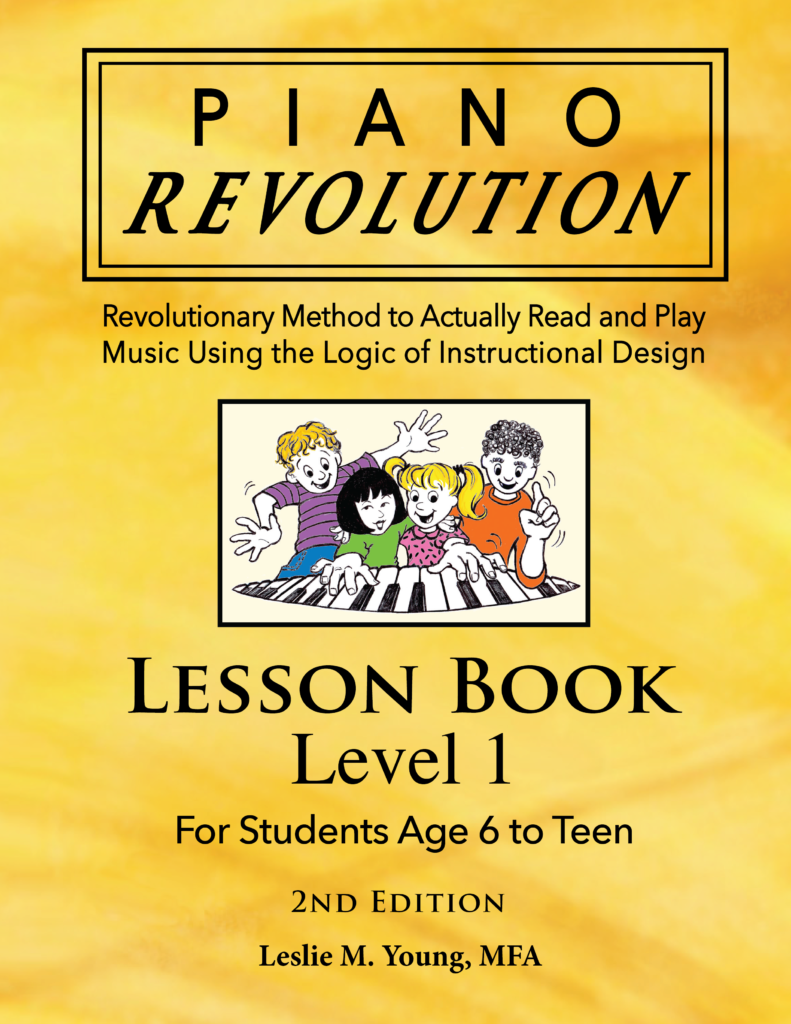
Why I Created Piano Revolution,
Teaching Beginners to Read Music
Personal Reflection by Leslie M. Young, author of Piano Revolution
Leveled Piano Instruction Books in Four Series
Why It Matters
The writing and proving of the Piano Revolution books has been a decades-long journey for me. The longer I used the method as a teacher, the more frequently I saw the lasting benefits for students of various ages. This approach truly teaches learners—proven with ages 5 to 65—how to actually read and play written music from the very first lesson. It’s not just about pressing keys. It’s about unlocking literacy in music and having independence.
Backstory: The Power of Instructional Design
In 1982 I observed a course at the University of North Texas that was about how Instructional Design principles can be used to teach anyone anything in a way that should practically guarantee successful learning. That one experience reshaped how I thought about teaching. It showed me that learning doesn’t have to be rote copying tied to hand positions and finger numbers—it can be logical, clear, and empowering. That’s exactly how Piano Revolution is structured – now.
I realized in the 1980s that just marking out most of the printed finger numbers in songs would not solve the root problem. Those songs were purposefully written in “hand positions” so that only certain notes would be read and certain piano keys played. A student has 10 fingers. A piano has 88 keys. Instant problem.
To alleviate this problem in the beginner’s first book, I searched for recognizable songs in the public domain that would fit my new “thinking process” strategy. This also meant new songs would have to be written to provide enough sequential progress for the student. There were years spent writing and rewriting.
Then something fantastic was created . . . the Internet! . . . and with it the capability for self-publishing books! New notation software – print on demand – no inventory – the book in your hand three days from ordering – amazing! This new “thinking process” method could be in the hands of teachers, students, and parents – all over the world.
The Thinking Process: Step-by-Step
The beginner learns each hand’s staff separately. This makes sense because each staff represents different portions of the piano keyboard—so that the lines and spaces of each staff have different letter names. After the spaces are gradually learned (and the location of their piano keys), the spaces are used to name and locate the line letter names and key locations, in a gradual and logical sequence.
This “thinking process” that the student acquires within a short time of repeated practice is exciting for a teacher to see in action and self-motivating for the students because they can self-correct any errors. I’ve had a student say, “I can figure this out myself, so why do I need a teacher?” That was very satisfying for me to hear!
Though the process can be used by anyone and everyone, the only real hindrances are a low level of maturity in young children and a lack of sufficient practice time for most everyone. To overcome these issues, an uninterrupted nearly-daily session of about 10 minutes of practice (that follows the guidelines) is all that is required for substantial and continued progression. Any parent knows that an immature child can use up 10 minutes making excuses not to be involved. Close personal supervision usually prevents wasted time for young students.
In some cases it takes a bit of time to discover that piano is not the instrument of choice. Some instruments use the same clefs as the piano, and if so, then the “thinking process” of Piano Revolution would be essential in learning to actually read the music for a different instrument. Greatest satisfaction results from learning to play the most preferred instrument, and that may take some time to determine since there are many choices.
The Method that Empowers Students to Teach Themselves
The evolution of structured teaching to read written music and perform it has spanned about 150 years. The Bertini Pianoforte Method of the 1880s was more like an encyclopedia of everything piano rather than a graduated method for beginners to learn to read and play – but it was a start. In the years after Bertini’s book appeared, other method books were published, including Beginners’ Book of the Oxford Piano Course in 1928 and John Thompson’s Modern Course for the Piano in 1942.
There are certainly more that followed, but modern piano method books seem to be organized in the same general way as that of the 1880s: Systematically gathering beginner concepts together, leading to more difficult, and then the even more difficult – this IS the methodology.
It would take a determined effort for a professional teacher to make a thorough comparison of the books available today. To break away from the popular methods that are generally accepted – and instead consider the logical benefits of Piano Revolution – this may seem revolutionary! A “thinking process” instead of rote-copy hand positions . . .
Piano Revolution gives students independence. It teaches them not just to play by rote-copying, but to understand. Not just to perform, but to logically think.
What Would the First Lesson for a Young Student Look Like?
What Would the First Lesson for a 6 to Teen Look Like (video)?
Piano Books for Beginners

Look through the many sample pages from every book on the PIANO Revolution website to decide which age series is best for you. Here they are altogether!

View sample pages of all the books for students
ages 6 to teen:

View sample pages of all the books for students
4 to 5 years old:

View sample pages of all the books for older
teens and adults:
View the books on Amazon:


Looking for a Homeschool Piano Method?
If you’re homeschooling and want a method that actually teaches your child how to read and play music, Piano Revolution is for you.
🎵 Ideal for:
- Homeschool families
- Busy parents
- Private piano teachers
- Self-taught piano learners
- College music major students needing fast, accurate piano skills
🎹 With Piano Revolution, students:
- Build true sight-reading skills
- Progress efficiently and confidently
- Develop real musical independence—no more relying on memory mnemonics, hand position fingering, or videos

About the Author, Composer, Illustrator, Educator, and Eternal Optimist
Leslie Young is the author/composer/illustrator of the Piano Revolution series of beginner piano instruction books. She co-founded a K-12th grade charter school in Texas and has been a piano teacher for about 40 years. She has had experience teaching a variety of students tackling piano for the first time or as returning students.
Young believes that “learning to play the piano is more about
diligence and perseverance” – but would add that just as critical
to success is the method that is used, the pattern of critical thinking, and the instructional principles that promote immediate success.
She states: “In teaching piano to students of varying ages, what also varies is a commitment of time and the amount of dedication. Children of certain ages may do very well with a parent as teacher; others may need someone who is not family to instruct them. Some older children and adults prefer to make progress on their own, and this method is designed to act as a meticulous guide through new material. Some adults and teens insist on professional teachers, which also encourages continuity. Because these books are self-explanatory, a new or experienced professional teacher will have no trouble using Piano Revolution with students. It’s an easy and effective way to learn piano.”
Hmm it looks like your blog ate my first comment (it was super long) so I guess I’ll just sum it up what I had written and say, I’m thoroughly enjoying your blog. I as well am an aspiring blog writer but I’m still new to the whole thing. Do you have any tips for inexperienced blog writers? I’d really appreciate it.
Youre so cool! I dont suppose Ive read something like this before. So good to search out someone with some original thoughts on this subject. realy thank you for starting this up. this website is one thing that’s wanted on the web, somebody with a bit of originality. helpful job for bringing something new to the web!